Graham Davies
Technical Product Manager – SCOM products

Migrating to SCOM 2025? Overrides — not the install — are what break most migrations. How to capture, triage, and clean up tuning before cutover.
Technical Product Manager – SCOM products
Series: The State of SCOM in 2026 — Part 4
By this point in the series, the decision is largely made: SCOM MI is retiring on September 30, 2026 (see our [SCOM MI retirement breakdown]), and SCOM 2025 UR1 has closed enough gaps to make on-premises redeployment a credible long-term platform (see our [UR1 feature breakdown]). What's left is execution —- and, as we'll cover in the next post, leaving alert tuning unmanaged carries a real, measurable cost.
So how do teams actually get the migration itself wrong? Almost never during the install. Almost always during override clean-up.
Every mature SCOM environment accumulates the same thing over years of operation: overrides. Thresholds tuned for a specific server that left production two years ago. Monitors disabled for "just this one app" that turned into every app. Tuning applied directly at the object level because nobody had time to do it properly through a sealed management pack. None of it documented, most of it half-remembered, and all of it currently keeping your production alerting quiet.
Lift-and-shift that into a new SCOM 2025 management group, and you've just recreated a decade of undocumented technical debt on a brand-new platform - plus you've likely dragged across the noise and drift you were trying to leave behind in the first place. Rebuild from scratch instead, and you've thrown away years of genuinely useful tuning along with the junk, and you're back to an alert storm on day one.
Neither option is good. This is exactly the gap a purpose-built tuning tool is designed to close, rather than trying to solve it with spreadsheets and tribal knowledge .Every mature SCOM environment accumulates the same thing over years of operation: overrides. Thresholds tuned for a specific server that left production two years ago. Monitors disabled for "just this one app" that turned into every app. Tuning applied directly at the object level because nobody had time to do it properly through a sealed management pack. None of it documented, most of it half-remembered, and all of it currently keeping your production alerting quiet.
Lift-and-shift that into a new SCOM 2025 management group and you've just recreated a decade of undocumented technical debt on a brand-new platform - plus you've likely dragged across the noise and drift you were trying to leave behind in the first place. Rebuild from scratch instead, and you've thrown away years of genuinely useful tuning along with the junk, and you're back to an alert storm on day one.
Neither option is good. This is exactly the gap a purpose-built tuning tool is designed to close, rather than trying to solve it with spreadsheets and tribal knowledge.
Each step is worth unpacking, since the risk isn't in knowing the sequence — it's in what "doing it properly" actually requires at each stage.
Overrides live in more places than most admins expect: sealed management packs, unsealed overrides, object-level tuning applied ad hoc. Before you can migrate cleanly, you need a real capture of effective tuning across your existing management group, not a guess based on whoever remembers configuring it.
Not every override earned its place. Part of migration planning is triage: which thresholds reflect genuine, considered tuning decisions, and which are legacy workarounds nobody has revisited in years. This is the point to leave the junk behind.
Whatever survives triage needs to move across in a way you can audit later, ideally exported in a format that plays well with change control, so tuning decisions in the new SCOM 2025 environment are traceable rather than reconstructed from memory a second time.
The moment a new management group goes live, tuning starts drifting again — someone applies a quick override under pressure during week one and nobody documents it. Catching that early is the difference between staying clean and rebuilding the same mess in twelve months.
Migration is the forcing function, but tuning discipline is ongoing. Time-of-day tuning for maintenance windows, automated tuning tied to provisioning, and scheduled drift checks all belong in steady-state operations, not just the cutover weekend.
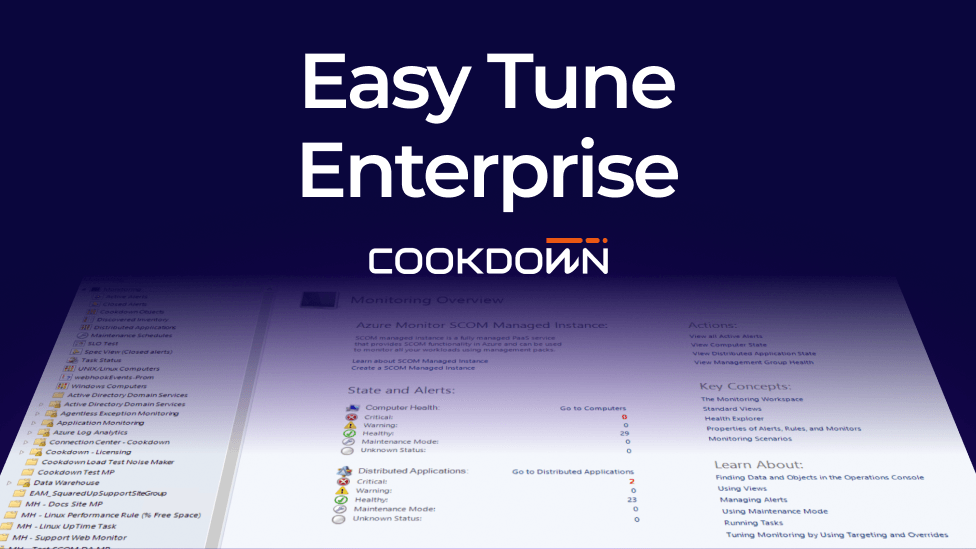
This is precisely the workflow Cookdown built Easy Tune Enterprise around, rather than treating alert tuning as a one-off scripting exercise:
The point isn't the feature list — it's that migration planning and long-term alert-tuning hygiene are the same discipline. Solve it properly once during the SCOM 2025 move, and you're not solving it again during the next platform migration.
Taken as a whole: SCOM MI's retirement forced the decision, the "is SCOM dead" myth got put to rest, SCOM 2025 UR1 made on-premises redeployment a platform worth committing to, and clean override migration is how you land on it without dragging a decade of alert noise along with you.
What you do with a clean, well-tuned SCOM 2025 estate afterward — turning that alert data into service-level operational intelligence rather than a console full of noise - is where we pick up next.
What are SCOM overrides, and why do they matter during migration? Overrides are threshold and monitor customizations applied on top of management packs - often at the object level, undocumented, and accumulated over years. During a SCOM migration, they're the most common source of either recreated technical debt (if lifted as-is) or a day-one alert storm (if left behind entirely).
Do management packs and overrides carry over automatically to SCOM 2025? Not cleanly. A straight lift-and-shift brings across both the useful tuning and years of undocumented noise. Most teams get better results by capturing effective tuning, triaging it, and reapplying only what's worth keeping in the new management group.
What is configuration drift in SCOM, and when does it start? Configuration drift is when tuning in a live environment diverges from its intended baseline - typically starting almost immediately after cutover, as quick fixes get applied under pressure and go undocumented. Catching drift early in the first few weeks post-migration prevents it from becoming a long-term problem.
Is override clean-up a one-time task or an ongoing process? Ongoing. Migration is a natural forcing function to clean up overrides once, but without continued drift monitoring and tuning discipline, the same noise tends to reaccumulate within a year.
Technical Product Manager – SCOM products